
ATLAS CONSULTANT AI · AYUMI
Your documents already know.Now your team can ask.
Connect the sources your business trusts. Atlas indexes them, answers only from them, and shows the exact clause behind every claim. Then it runs the checks your reviewers run by hand.
- Grounded answers
- Clause-level evidence
- Approved sources only
WHAT MAKES IT DIFFERENT
It answers from your sources, or it does not answer.
A general chatbot will answer anything, confidently, from nothing you can check. Atlas is the opposite: each consultation is scoped to a set of sources you approved, and every material claim carries the clause it came from. When the approved documents do not support an answer, saying so is the correct behaviour — not a failure.
Ayumi answers only from the sources chosen for this consultation, and shows the exact clause behind every claim.
WHY THIS, WHY NOW
Document work delays decisions and quietly adds risk.
Policies change, files multiply and the people who know are busy. The cost shows up as slow answers and inconsistent judgements rather than as a line item.
Answers take too long
Teams search folders, ask the same colleagues again and compare versions by hand while a customer, a tender or a project waits.
Rules get applied differently
Two reviewers reach two conclusions because the requirement lives across a policy, a template and somebody's mail.
Missing details get expensive
An omitted clause, an unsigned annex, an absent attachment — usually found after approval, when changing it costs the most.
Knowledge leaves with people
Senior staff repeat basic reviews, and what they know stays in personal folders and memory rather than in anything the team can query.
THE RUNNING PRODUCT
This is the console, not an impression of it.
Both screens below are the Ayonix Consulting AI console as it runs today. Nothing in them is composed for this page.
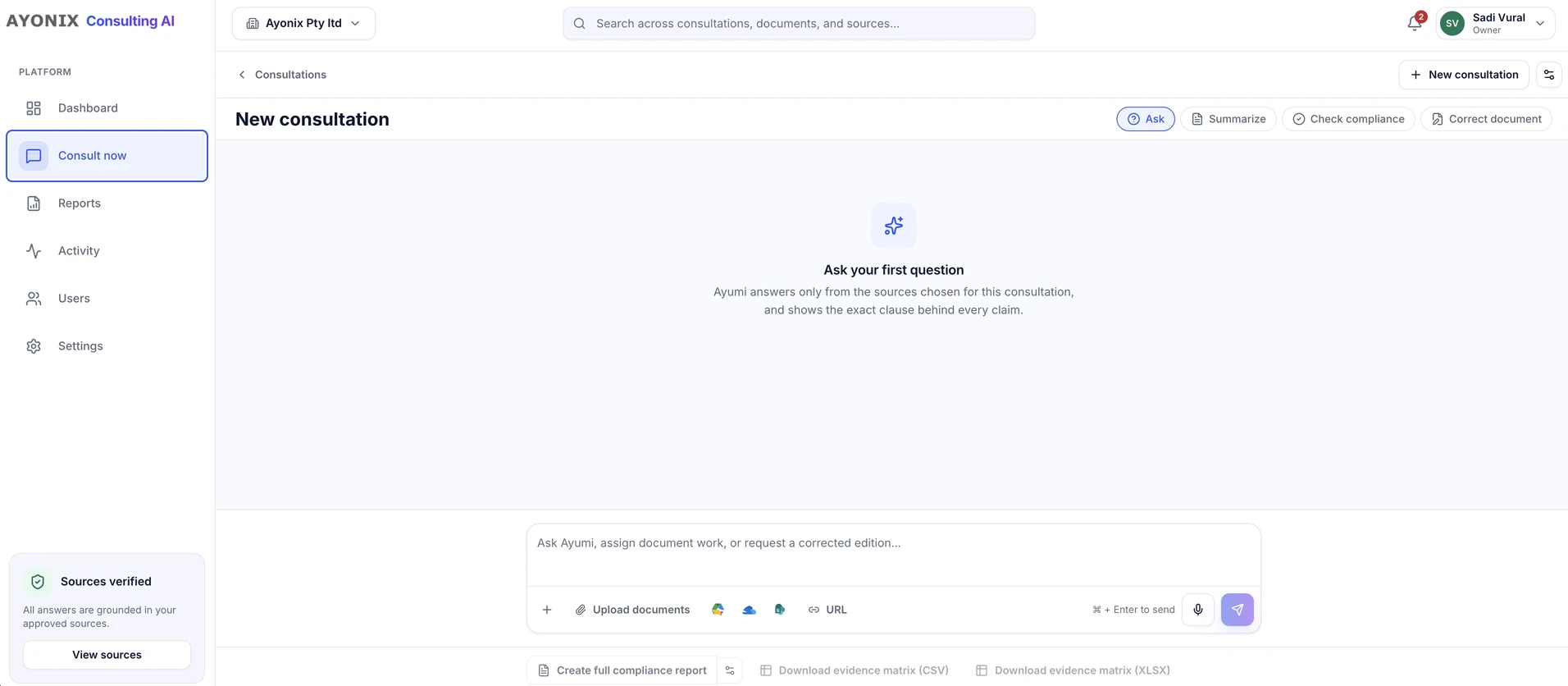
Consult now
A consultation opens against the sources you chose for it. Four jobs sit across the top — ask a question, summarise, check compliance, correct a document — and the composer takes an upload, a cloud file or a URL. The footer produces a full compliance report and exports the evidence matrix as CSV or XLSX.
- Ask, summarise, check compliance, correct a document
- Upload, cloud file or URL into the same composer
- Full compliance report and evidence matrix export
The knowledge base
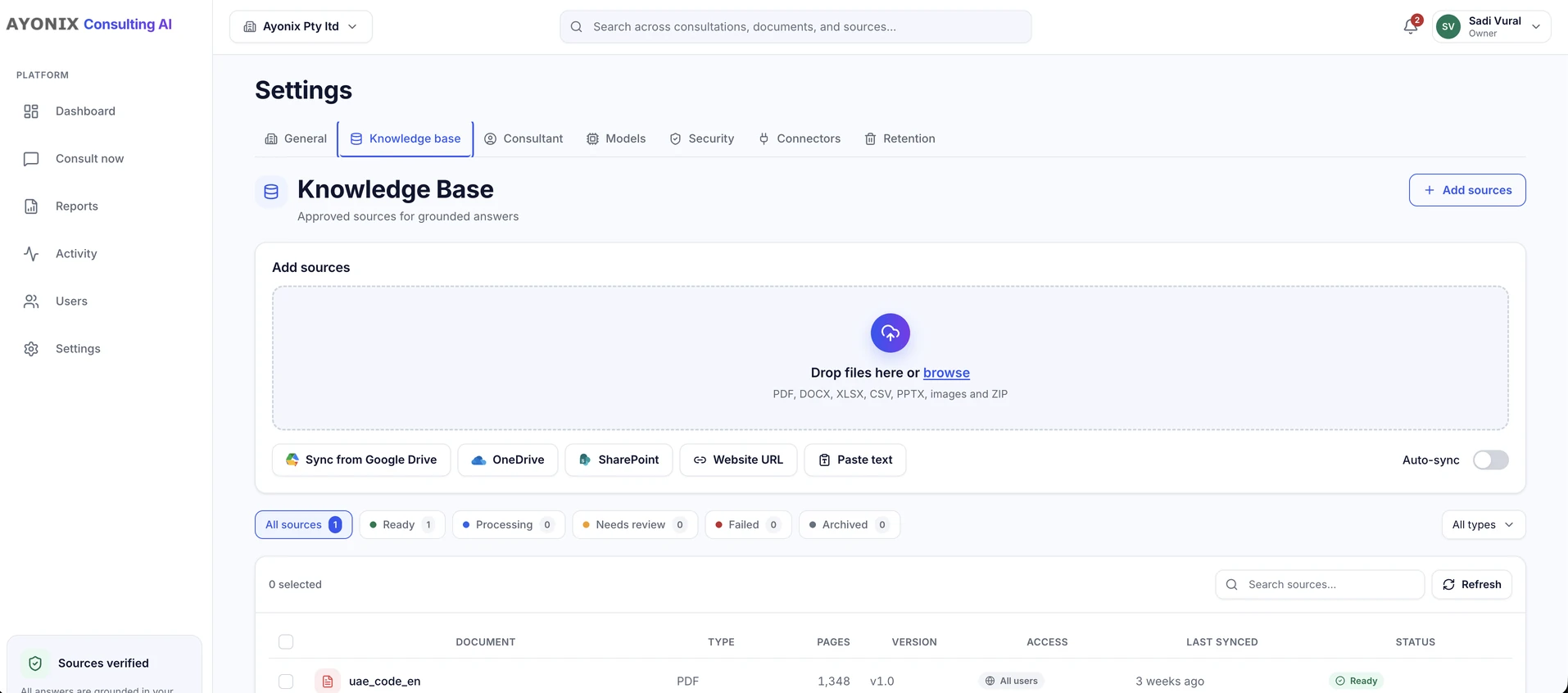
Sources are approved before they can ground an answer. Each one carries its type, page count, version, who may reach it and when it last synced, and sits in a state a reviewer can act on: ready, processing, needs review, failed or archived. Settings around it cover the consultant itself, models, security, connectors and retention.
- Ready, processing, needs review, failed, archived
- Type, pages, version, access and last sync per source
- Settings for the consultant, models, security, connectors and retention
WHAT IT READS
What you can put in, exactly as the console puts it.
The formats and sync sources below are the ones the product offers today. They are listed here in the product's own words rather than as a capability summary, so there is nothing to interpret.
Upload formats
PDF, DOCX, XLSX, CSV, PPTX, images and ZIP.
- PDFManuals, contracts, codes, reports
- DOCXPolicies, proposals, procedures
- XLSXTables, registers, models
- CSVStructured records
- PPTXDecks and diagrams
- ImagesScans and photographed pages
- ZIPBundles of the above
Sync sources
Google Drive, OneDrive, SharePoint, a website URL or pasted text, with auto-sync where you want it.
- Google DriveFolder sync
- OneDriveFolder sync
- SharePointSite sync
- Website URLPage capture
- Pasted textDirect entry
Drawings and CAD are scope, not a shipped format
The console's upload line stops at images and ZIP. Engineering review that depends on reading a drawing file — DWG, DXF or a native CAD export — is work Ayonix can scope and build for your deployment, not something the product parses today. Ayonix will tell you which side of that line your documents fall on before you commit to anything.
How large a knowledge base can be
Each consultant has its own approved source set, and the size that set is allowed to reach is part of your configuration rather than a fixed number published here. Ayonix confirms the limit for your deployment during discovery, against the documents you actually intend to load.
DOCUMENT INTELLIGENCE
Six review jobs. One evidence trail.
Retrieval finds the passage. A review job applies your approved rules across a whole document set and explains every finding it reaches.
Compliance check
Compare documents against the regulation, policy, standard or contract that governs them, and separate a confirmed failure from something a person still has to judge.
REVIEW AT OPERATIONAL SCALE
Every finding, its source and its owner in one view.
A completed check is a list of findings, each one carrying the clause it came from, a severity, a state and somebody responsible for it. That list exports, and the export is what an auditor reads.
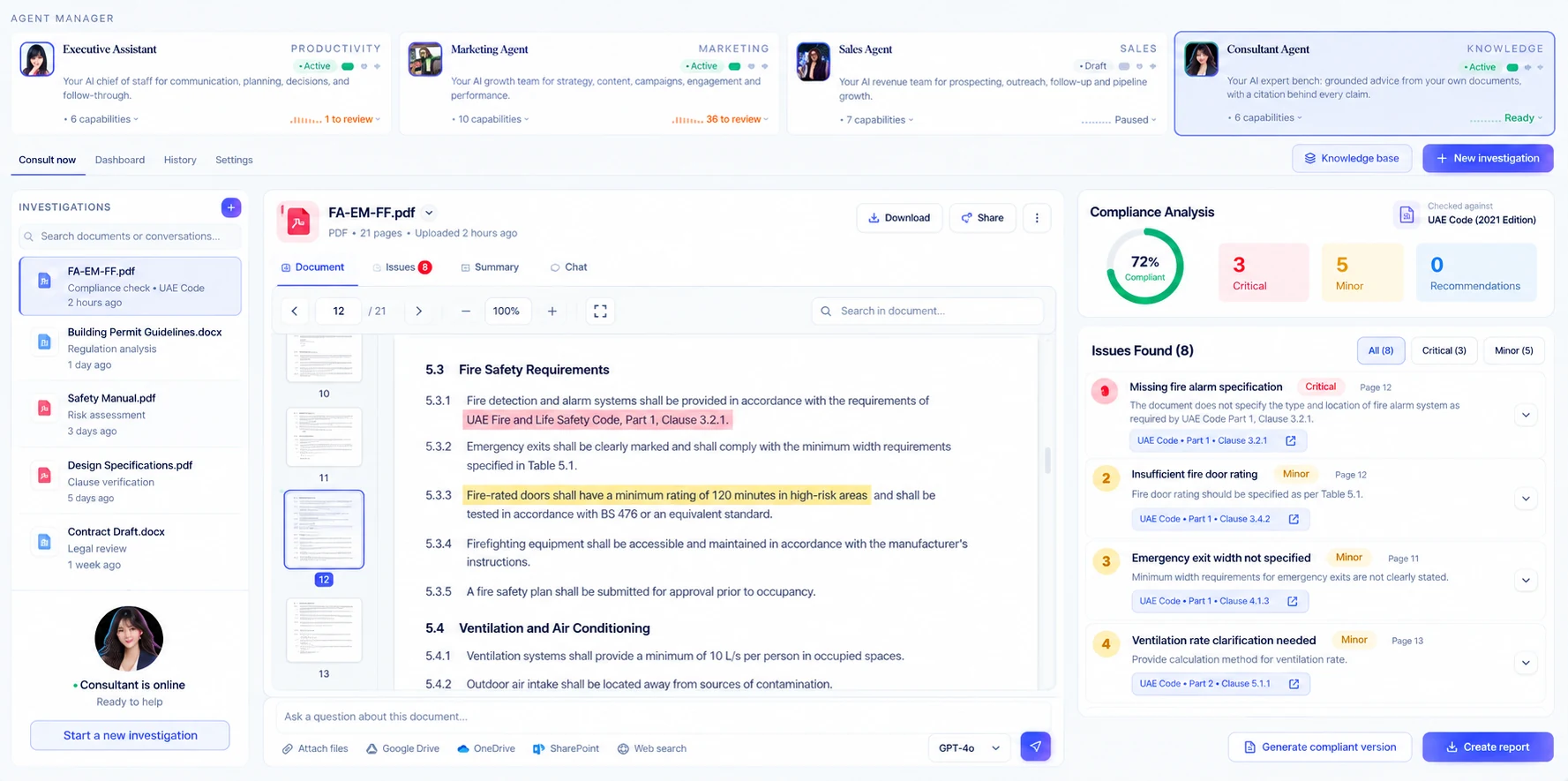
- Pass, fail, warning and needs-review states
- Clause-level evidence with the version it came from
- An owner, a due date and a resolution note per finding
- Evidence matrix as CSV or XLSX, and a full report
ANSWER CONTROL
Ask for the answer the decision needs.
The same question deserves different answers depending on who is asking and what they will do next. The depth is yours to choose, and the evidence does not change with it.
The answer, and what it rests on
A decision and the clauses behind it, for somebody who needs to act now and will read the source only if they disagree.
- The conclusion first
- The governing clauses
- Nothing else
And the fourth answer
When the approved sources do not support a conclusion, the useful response is to say so and show what was searched. An answer assembled past the evidence is worse than no answer, because somebody will act on it.
ONE COMPLETE SYSTEM
From a folder nobody reads to an answer somebody can sign.
Ingestion, indexing, retrieval, verification and review sit in one system, so a claim can be traced back to a page without leaving it.
Connect
Sync an approved folder or site, or upload a controlled set. Each source is approved before it can ground anything.
Understand
Parse the text, the tables and the scanned pages, keep the document's structure, and record its version.
Reason
Retrieve on both meaning and wording, respect the document's own structure, and apply the instructions written for this consultant.
Verify
Attach the page, section or table behind every material claim — and refuse where the sources do not carry one.
Act
Run the checks, produce the findings, export the evidence matrix and send the result where the work continues.
AROUND THE ANSWER
Five sources today. The rest is scope Ayonix can build.
The distinction on this page is deliberate. What the console offers is listed as what it offers. Everything else is named because customers ask about it, and named as work rather than as a status.
The five ways documents come in
These five are what the knowledge base offers for bringing documents in, with auto-sync where you want re-indexing to happen on its own.
- Google DriveFolder sync
- OneDriveFolder sync
- SharePointSite sync
- Website URLPage capture
- Pasted textDirect entry
Nothing in the second and third groups is a published connector, and no platform named here endorses, certifies or has reviewed Ayonix. They are systems Atlas is designed to reach, and what it would take is settled in discovery.
GOVERNANCE
The controls are in the product, not in a promise.
Security, models, connectors and retention are settings screens in the console. What each one is set to for your deployment is decided with you, in a security review, before anything is loaded.
- Access
- Each source carries who may reach it, and each consultant carries its own access group. An answer cannot cite a document the person asking is not allowed to see.
- Activity
- Questions, answers, sources, checks and actions are recorded, so a decision can be reconstructed months later by somebody who was not there.
- Models
- Which models a consultant may use, and where they run, is configuration rather than something fixed in the product. Ayonix sets it with you.
- Retention
- How long consultations, sources and exports are kept is a setting, and deletion is part of it rather than an exception to it.
- Instruction safety
- Retrieved content is treated as material to read, not as instructions to follow, so a document cannot redirect the consultant that is reading it.
- Human review
- A finding that carries consequence goes to a person. The product's job is to make that review fast and evidenced, not to remove it.
Ayonix publishes no security certification for this product, and this page claims none. Encryption, key management, sign-on, residency and audit requirements are answered in writing during the security review for your deployment.
WHERE IT RUNS
Including on infrastructure you own.
Atlas runs on hardware the customer controls, fully offline where that is the requirement — the same thing Ayonix has always done for face recognition. Managed cloud and private-cloud patterns are designed with you rather than picked from a list.
- Corroborated
On your own infrastructure
Documents and answers stay inside your network, including with no outbound connection at all. This is the deployment Ayonix has the longest history with.
- Designed with you
Private cloud
Your own tenancy and region, sized for your document volume and the models you approve.
- Designed with you
Managed by Ayonix
Ayonix operates it, with the residency, retention and model rules agreed before anything is loaded.
WHERE IT PAYS FIRST
Start where a document review is already expensive.
One consultant, one document set, one workflow that costs real time today. Departments get their own consultant and share the administration.
Engineering
Specification review
Compare technical submissions against requirements, standards and the project's own specifications, and find what is missing before it is approved.
Legal and procurement
Contract and supplier compliance
Find missing clauses, deviations, expired evidence and obligations nobody has closed out, across a supplier pack rather than one document at a time.
Quality and manufacturing
SOP and audit readiness
Check procedures, forms and evidence against the controlled template and the rules that govern it, before the auditor does.
Government
Policy and case knowledge
Give staff a traceable answer across policy, guidance and past decisions, with the clause attached so the answer can be defended.
Finance
Diligence and controls
Work through a large document set, surface what is inconsistent between its parts, and produce an evidence pack rather than a summary.
Customer operations
Expert answer desk
Answer product, service and policy questions from the approved documentation, so escalation is for the cases that deserve it.
THE FIRST ENGAGEMENT
Four weeks, your documents, a test agreed in advance.
Pick one document review that costs real time. Ayonix defines the success test with you before configuring anything, so the result at the end is a measurement rather than a demonstration.
- Week 1
Scope and evidence
Choose the documents, the questions, the rules and the measures the pilot will be judged by.
- Week 2
Connect and index
Configure access, parsing, metadata and retrieval against the real source set.
- Week 3
Evaluate and tune
Test the answers, the citations, the refusals and the review jobs against what was agreed in week one.
- Week 4
Decide
Read the scorecard together, then decide on the operating model and what production would need.
What gets measured
- Whether the right source was retrieved for each question
- Whether the citation actually supports the claim
- Whether a refusal happened when it should have
- Whether two runs of the same check agree
Ayonix publishes no benchmark figure for this product, because the only number that matters is the one produced on your documents. These are the measures the pilot reports against.
BEFORE YOU CONNECT A FOLDER
The questions worth asking first.
What is Atlas Consultant AI?
An enterprise document consultant. It connects to the sources you approve, answers questions from those sources with the clause behind each claim, and runs repeatable checks for compliance, rules, templates, missing points and layout. Ayumi is the consultant's name in the product interface.
How is it different from a general chatbot?
A general chatbot answers from everything it was trained on and can show you none of it. Atlas is scoped to the documents you approved for a consultation, attaches the clause behind material claims, confirms an ambiguous question before running an expensive analysis, and declines when the approved sources do not support an answer.
Which file formats can I load today?
The console accepts PDF, DOCX, XLSX, CSV, PPTX, images and ZIP. That is the current upload line, not a summary of it.
Does it read CAD drawings?
Not today. The console's upload line stops at images and ZIP, so a native drawing file is not a format the product parses. Drawing and CAD review is work Ayonix can scope and build for your deployment, and Ayonix will say plainly which of your documents fall on which side of that line.
Which systems can it sync from?
Google Drive, OneDrive, SharePoint, a website URL and pasted text, with auto-sync where you want re-indexing to happen on its own. Other repositories — Box, Dropbox, object storage, an on-prem file server — are integration scope: Atlas is designed to reach them, and building the connector is part of the engagement rather than something already published.
How many documents can one consultant hold?
The size of a consultant's approved source set is part of your configuration rather than a number this page publishes. Ayonix confirms the limit for your deployment during discovery, against the documents you actually intend to load.
Can each department have its own consultant?
Yes. Each consultant has its own knowledge base, instructions, access group, answer policy and review jobs, while administration, activity and user management stay central.
Can it run on our own infrastructure?
Yes, including fully offline, which is the deployment Ayonix has the longest history with. Private-cloud and Ayonix-managed patterns are designed against your residency, model and integration requirements rather than sold as tiers.
Is Ayumi a separate product?
No. Ayumi is the consultant persona — the name and face the product gives this agent. The capability on this page is Atlas Consultant AI; the persona is how people address it.
BRING ONE REAL WORKFLOW
Show us the question your team keeps re-answering.
Bring the documents, the rules and the review that costs your team the most time. Ayonix will design the first consultant around it and agree how you will judge the result.